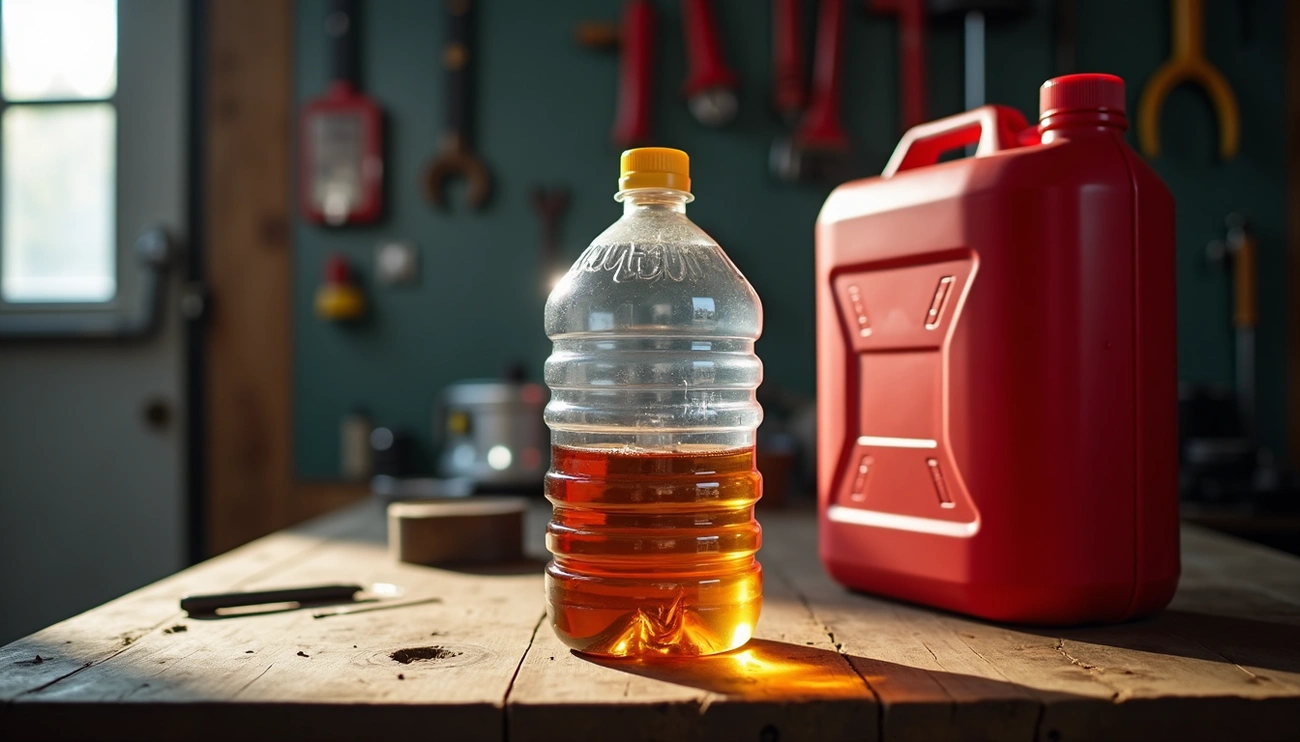
No, you should not put gasoline in a water bottle. Gasoline dissolves common plastics, causing leaks and vapor release. Gas fumes ignite easily at temperatures as low as −45°F (−43°C), creating fire and explosion risks. Store gasoline only in approved, labeled fuel containers.
Throughout this article, we’ll explore why people put gas in water bottles, what actually happens when they do, and safer alternatives for transporting fuel during your adventures. Whether you’re wondering about emergency options or curious about the legality, we’ll cover everything you need to know about this potentially hazardous practice.
Why do people consider using water bottles for gas?
Despite safety concerns, people often consider using water bottles to store gasoline. Considering the potential hazards, why would anyone even think about putting gas in a water bottle? Let’s explore the common reasons behind this risky practice.
Emergency situations and lack of options
Running out of fuel on a deserted highway creates desperate situations. Many riders have found themselves stranded with an empty tank and limited options. One motorcyclist reported that after running out of gas, they picked up an empty gallon jug from the roadside, filled it at a station, and successfully refilled their tank.
Some travellers have even reported highway patrol officers bringing them fuel in water bottles as an emergency measure. These situations highlight how desperation often leads to improvised solutions when proper equipment isn’t available.
Furthermore, in remote areas or foreign countries, approved containers might be completely unavailable. In Vietnam, for instance, selling gasoline in water bottles along roadsides is a common practice. Nevertheless, emergency circumstances don’t eliminate the serious risks involved.
Convenience and availability of water bottles
The widespread availability of plastic bottles makes them an appealing option when proper containers aren’t readily accessible. Many people discover that standard 1-2 2-litre soda or water bottles are convenient to carry when traditional gas cans won’t fit in their storage spaces.
Some motorcycle and dirt bike riders specifically mention that regular soda bottles fit perfectly in saddlebags or backpacks, whereas standard gas cans are too bulky. Moreover, cost becomes another factor – proper fuel containers typically cost $17-20, which can seem excessive for a one-time emergency use.
Bicycle tourists and campers frequently consider water bottles for carrying alcohol fuel because they fit perfectly in standard water bottle cages on bikes. Certain riders who use camelbacks for hydration might repurpose their now-empty water bottle holders for fuel storage on extended trips.
Misconceptions about material strength
One persistent misconception comes from riders who believe regular plastic soda bottles can safely store gasoline “forever” since they’ve personally used the same bottle for years without incident. Others specifically recommend energy drink bottles, claiming they have “superb plastic and very strong caps”.
Not all plastics react identically with petroleum products:
- Some plastics may dissolve in seconds when exposed to gasoline.
- Others might gradually soften over days or weeks.
- Even when the container seems intact, chemical leaching and vapour permeation can occur.
The reality is that unless a container is specifically manufactured and rated for fuel storage, users risk serious consequences. However, these beliefs directly contradict expert knowledge about plastic-fuel interactions.
What happens when you put gas in a water bottle
Putting gasoline into a water bottle can trigger a dangerous chemical reaction that most people don’t fully understand. The interaction between fuel and plastic isn’t just about immediate leaks—it involves complex molecular processes that occur even when everything appears normal from the outside.
Gasoline’s effect on plastic over time
Standard water bottles aren’t designed to withstand gasoline’s aggressive chemical properties. First thing to remember, gasoline molecules can actually “wiggle through” the polymer chains in untreated HDPE plastic (the kind used for water bottles) through a process called permeation. Even when there’s no visible leak, the container will ‘sweat’ flammable vapours, creating an invisible explosive cloud awaiting an ignition source.
Over time, gasoline causes standard plastic containers to:
- Soften considerably
- Swell beyond their original dimensions.
- Eventually degrade structurally
- Form microscopic pathways for fuel to escape.
This degradation timeline varies based on the plastic type. Untreated HDPE containers may hold gasoline for 3-6 months before significantly deteriorating. Consequently, these containers will eventually rupture or leak, often without warning.
Modern fuel blends containing ethanol (like E10 gasoline) create additional complications. The ethanol component absorbs water from the atmosphere, potentially leading to phase separation within the container. This water content creates an environment where microbes can grow, further degrading your fuel quality.
Cap and seal degradation risks
The cap system of water bottles presents its own unique dangers. Plastic caps are typically the first component to fail when exposed to gasoline vapours. One experienced user reported that after trying multiple cap types on aluminum bottles, “they always degrade over time.”
The degradation process typically follows this pattern:
- Plastic threads begin softening.
- Cap seals swell and deform.
- Gasoline vapours escape around compromised seals.
As one user explained, even specialized fuel bottle caps designed for other fuels, like paraffin, often can’t withstand gasoline, noting, “after a few weeks the vapours had started to soften the plastic threads again!” This softening creates immediate leakage risks plus dangerous vapour release.
Pressure build-up and expansion issues
Unlike water, gasoline is highly volatile and responds dramatically to temperature changes. On a hot day, gasoline heats up and expands significantly, creating pressure inside any container. Water bottles lack the pressure-release mechanisms found in proper fuel containers.
This pressure build-up creates several dangerous scenarios:
- Potential rupture of weakened plastic
- Forceful spray when opening a pressurized container
- Increased rate of vapour release through compromised seals
The temperature factor cannot be overstated. Plastic is a poor heat conductor compared to metal containers, meaning gasoline in plastic water bottles gets hotter faster in sunlight. This increased temperature accelerates the fuel’s volatility rate (how quickly it vaporizes), creating a dangerous cycle of increasing pressure.
Is it illegal to put gas in a water bottle?
The short answer is yes, it’s absolutely illegal to put gasoline in a water bottle. This practice violates multiple laws and regulations designed to protect public safety.
Laws and regulations in the US and other countries
Across the United States, storing or transporting fuel in non-approved containers directly violates federal regulations. The Portable Fuel Container Safety Act of 2020 mandates that all portable fuel containers include flame-retardant devices that prevent fire from spreading within the container. Likewise, Florida state law explicitly prohibits possessing vessels equipped with containers designed to hold gasoline if those containers don’t conform to federal regulations.
Beyond American borders, other countries have implemented similar restrictions. In India, carrying petrol in plastic water bottles is strictly prohibited under the Petroleum Act and Petroleum Rules. Recently, the Indian state of Odisha announced strict enforcement of its ban on selling gasoline or diesel in plastic bottles, citing “serious public safety, fire hazard, and environmental concerns”.
Why are approved containers required?
Legal requirements exist primarily because proper fuel containers incorporate critical safety features that regular bottles lack. According to Consumer Product Safety Commission (CPSC) regulations effective July 12, 2023, gas cans and other fuel containers must include flame mitigation devices. These specialized containers are designed with:
- Flame arrestor screens to prevent flashback
- Spring-closing lids to minimize vapour escape
- Pressure-relief mechanisms to prevent explosions
- Chemical-resistant materials that won’t degrade
Proper gasoline containers also use colour-coding—typically red for gasoline, yellow for diesel, blue for kerosene, and green for oils—to prevent dangerous mix-ups.
Fines and legal consequences
The penalties for storing fuel in unauthorized containers can be substantial. In Florida, violations are considered misdemeanours of the second degree. Authorities can seize not only the gasoline but also potentially confiscate the vehicle or vessel containing the improperly stored fuel.
In India, first-time offenders face imprisonment for up to one month, a fine of up to ₹1,000, or both. Repeat offenders risk imprisonment for up to three months, a fine of up to ₹5,000, or both.
Notably, enforcement often happens at gas stations themselves. Many jurisdictions require fuel stations to display signs stating, “Petrol/Diesel shall not be sold in plastic bottles or unauthorized containers. Violators will be prosecuted.” As a result, attendants may refuse service if they observe customers attempting to fill inappropriate containers with fuel.
Real dangers of using non-approved containers
The theoretical dangers of storing gasoline in water bottles become horrifying realities when examining actual incidents. Improper fuel storage continues to cause preventable tragedies each year, with consequences far worse than most people anticipate.
Accidental ingestion and mislabeling
One of the most alarming risks occurs when someone mistakenly drinks gasoline from a water bottle. In Essex County, a child required emergency treatment after drinking from a 5-gallon water bottle contaminated with gasoline. This isn’t an isolated incident; following Hurricane Sandy, some Poland Spring water bottles became contaminated when people used empty water containers to transport gasoline during fuel shortages.
The consequences of ingestion are severe. Swallowing even a small amount—just 10-15 grams (less than half an ounce) in children—can be fatal. An actual case involved a 4-year-old who took just one sip of gasoline, resulting in coughing, choking, vomiting, pneumonia development, and hospitalization. Primarily, these accidents occur because gasoline in unmarked containers creates confusion that can be life-threatening.
Fire and explosion risks
Beyond ingestion, storing gasoline in water bottles creates serious fire hazards. The Consumer Product Safety Commission found that portable containers were involved in an estimated 17% of the 9,600 gasoline burn injuries in 1978. More recently, analysis revealed at least 11 deaths and 1,200 emergency room visits from gas container explosions since 1998.
These explosions happen because:
- Vaporization of less than one-half pint of gasoline can fill an entire garage with explosive vapours.
- Plastic bottles lack flame arrestors that prevent flashback explosions.
- Gas vapours can be ignited by numerous sources, including static electricity, pilot lights, or cigarettes.
In laboratory tests, researchers confirmed that under certain conditions, gas vapour mixtures can explode inside containers when vapour escaping the container contacts an ignition source.
Stories from riders and campers
Real-life incidents tell a sobering story about the dangers. In one tragic case, two women at a campground smelled what they thought was garlic (actually propane) and lit candles to mask the odour, causing an explosion. Subsequently, another incident involved someone transferring propane between tanks while a lit candle was nearby, resulting in an explosion that completely engulfed their motorhome.
RV owners face particular risks—one propane explosion completely destroyed a motorhome, blowing the upper half of the walls and entire roof off the rig. Another fatal explosion occurred when propane leaked beneath a camper and was ignited by a lit candle. Most disturbingly, many of these tragedies were entirely preventable with proper containers and safety practices.
What to use instead of a water bottle
Instead of risking safety with improvised solutions, several purpose-built containers offer secure fuel storage options. These specialized containers prevent the hazards associated with putting gas in a water bottle while remaining portable and convenient.
MSR fuel bottles
MSR fuel bottles provide an excellent alternative for motorcycle riders and campers. Made from impact-extruded aluminum with no seams or welds, these bottles resist cracking, leaking, and bulging under pressure.
Available in sizes from 11 to 30 ounces, they feature threads machined into the neck for a lasting seal. Many riders carry multiple bottles, as thirty ounces of gas could provide another 20-30 miles of range.
RotoPax and Reda containers
RotoPax containers represent the gold standard in portable fuel storage. They’re the only rotationally moulded EPA and CARB-compliant fuel containers available in the US, thanks to a patented three-layer process with specially formulated plastic barrier material.
Alternatively, the REDA Gas Can is made of a special plastic material with a layering process that makes it 100% vapour-proof. Designed to fit perfectly in motorcycle hard bags, it includes Viton rubber gaskets that contain vapours and prevent spills.
Small approved plastic gas cans
Properly designed gas cans incorporate critical safety features that water bottles lack. These containers:
- Include flame arrestors to prevent flashback explosions.
- Features spring-closing lids minimizing vapour escape.
- Provide pressure-relief mechanisms
- Utilize chemical-resistant materials that won’t degrade.
Tips for safe mounting and transport
Primarily, secure your containers properly. A full five-gallon fuel tank becomes a projectile with 1,872 pounds of force in a 35 mph crash. Therefore, use dedicated mounts rather than improvised solutions. Certainly, specialized options like RotoPax’s unique screw-action mounts allow secure attachment to virtually any surface.
Conclusion
Storing gasoline in water bottles might seem like a convenient solution during emergencies, but the risks far outweigh any short-term benefits. Throughout this article, we’ve seen how gasoline chemically degrades plastic bottles, compromises cap seals, and creates dangerous pressure build-up. Additionally, this practice violates federal regulations across numerous countries for good reason.
Safety must always come first when handling flammable fuels. One mistake could lead to accidental ingestion, devastating fires, or potentially fatal explosions. These aren’t merely theoretical concerns—real people have suffered serious injuries and even lost their lives due to improper fuel storage.
Fortunately, several purpose-built alternatives exist that eliminate these risks while still providing portability. MSR fuel bottles offer excellent durability for small quantities, while RotoPax and Reda containers provide certified safety for larger volumes. Even small approved gas cans incorporate crucial safety features, such as flame arrestors and pressure-relief mechanisms, that water bottles don’t.
